Basic principles
1. Permaculture
Permaculture is a systemic and global method that aims to design
resilient systems inspired by nature (biomimicry).
It is not a fixed method but a "mode of action" that takes into consideration the biodiversity of each ecosystem.
It aims at sustainable agricultural production, very energy-efficient (both in terms of the use of fossil energy and manual and mechanical work) and respectful of living beings and their reciprocal relations, while leaving as much room as possible for "wild" nature.
2. The principles of permaculture
We recognize ourselves in the conceptual approach of permaculture. In line with these values, we seek to design resilient systems in an open and collaborative approach.
Principle 1: Observe and Interact
Principle 2: Collect and store energy
Principle 3: Create a production
Principle 4: Apply self-regulation and accept feedback
Principle 5: Use and develop renewable resources
Principle 6: Do not generate waste
Principle 7: Start from the overall structures to get to the details
Principle 8: Integrate rather than separate
Principle 9: Use small-scale solutions with patience
Principle 10: Use and value diversity
Principle 11: Use interfaces and value border elements
Principle 12: Use and respond to change, creatively
3. Aquaponics and the nitrogen cycle
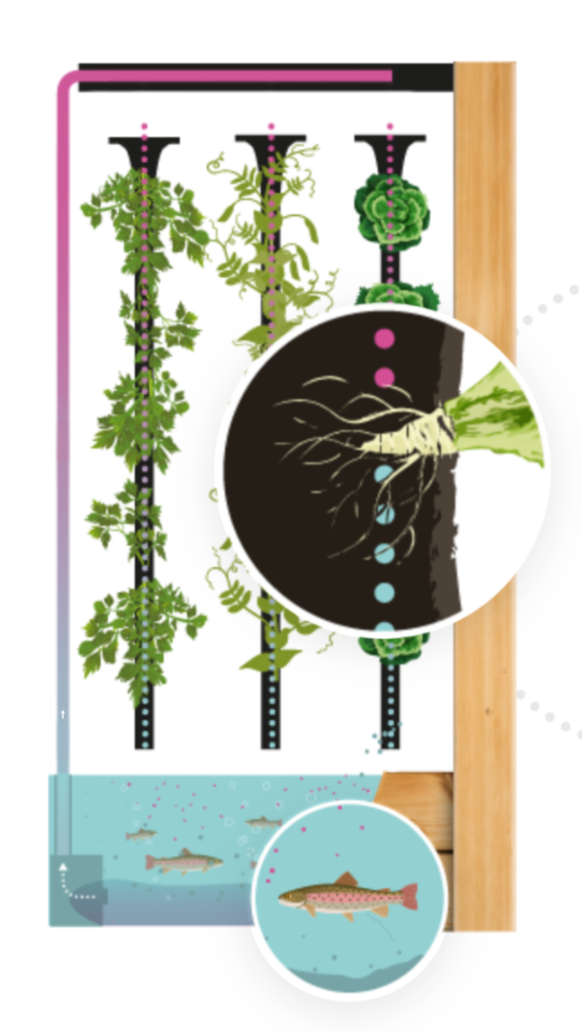
Aquaponics is a cultivation technique that combines fish farming and plant cultivation.
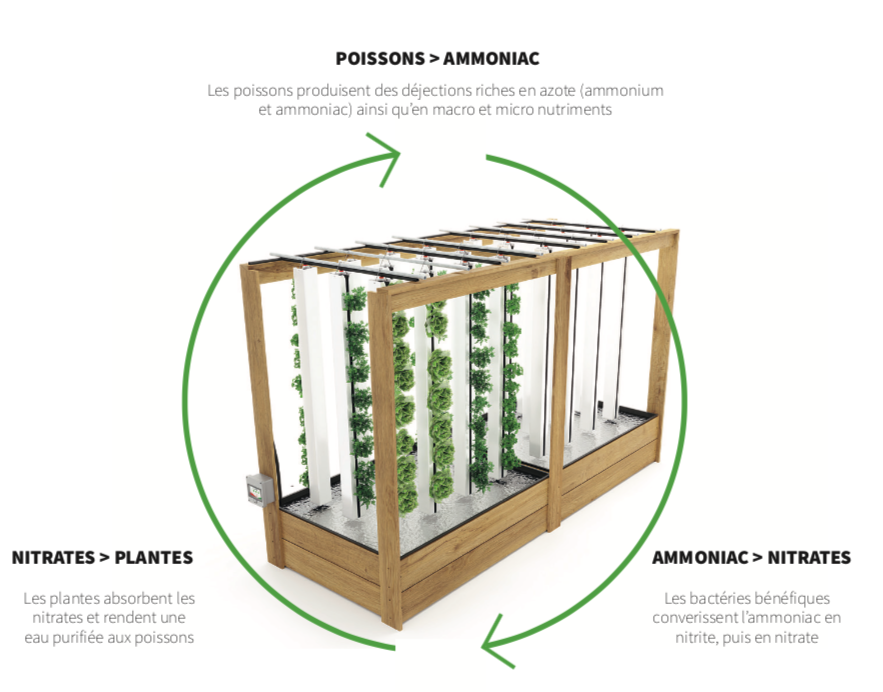
In an aquaponic system[on a permaculture principle] we strive to minimize the production of waste.
Whether growing in open ground or above ground, beneficial bacteria are important in converting ammonia to nitrites and then nitrates for plants.
This natural process converts faeces into organic food for plants. For this to happen, it is important for bacteria to have as much biological surface area as possible.
4. The lexicon of aquaponics
pH: hydrogen potential
PH measures acid ions in water. It is important to keep it balanced in order to promote a healthy ecosystem for fish. Imbalanced pH can cause nutrient deficiencies in plants and promotes disease in fish and plants. For example, too high a pH will tend to promote iron deficiencies. This rate is measured in real time by a sensor in your pools.
•
This is the indispensable process in organic farming. During this process, bacteria successively and naturally transform the organic waste into ammonia, nitrites and then nitrates, that is to say, into fertilizer for plants.
Dissolved oxygen or DO
Oxygen is essential for fish, bacteria and plants to breathe. The level of DO in water can be affected by the presence of algae, high temperature, decomposing matter or increased bacteria.
Carbonates
The hardness of the water or the presence of carbonates is an important element to consider in an aquaponics system. Indeed, a high concentration of carbonate in the water creates a buffer effect which influences variations in acidity. The water in the network is generally hard (KH > 5) unlike rainwater or osmosed water.
The seasons: temperature and light
Over the seasons, changes in climate influence water and air parameters, affecting fish behaviour and vegetable growth. Light is the most limiting factor for plant growth in Northern Europe in winter (short days).
Fish feed: nutrient intake
Fish feed turns into nutrients for your plants. A diet rich in protein and amino acid is fundamental for the growth of fish and plants.
5. Vertical Cultivation with ZiGgrow Towers
ZipGrow cultivation towers offer higher yields than conventional cultivation techniques. It is the most advanced vertical technology on the market. Designed for maximum production, their unique cultivation face and white color optimizes light reflection and allows cultivation in high density, without artificial light.
Their filter substrate, the culture matrix, has 960 m²/m3 of specific surface area (3 times more than usual substrates or filtration systems), while providing large aerobic zones for bacteria and a stabilized temperature favorable to the roots.
This technology significantly increases the profitability of your greenhouse, whether in bioponics or aquaponics.
6. Bioponics or organic hydroponics
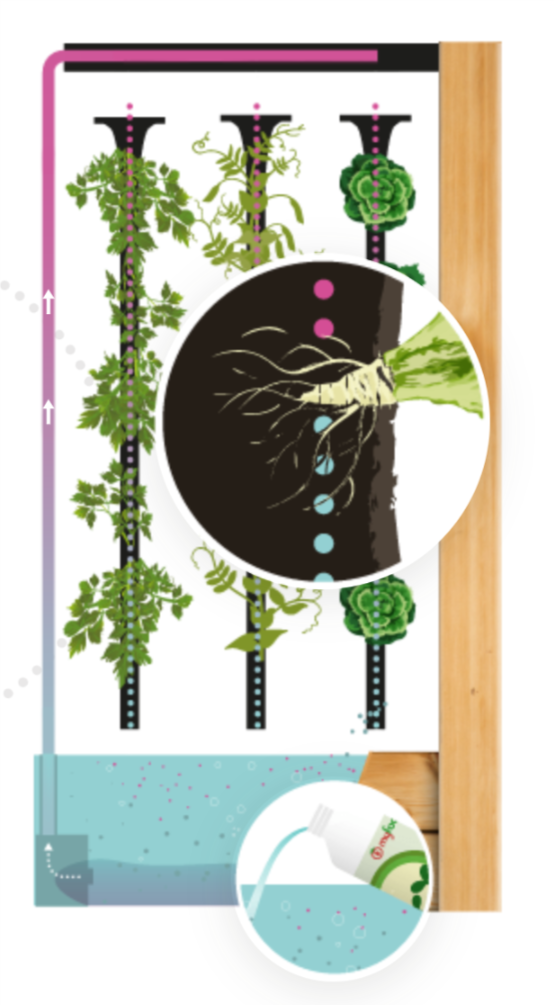
Biopony (Patent No. 05.11569 - 15/11/05) is a method of growing plants above ground by providing in water the organic nutrients that the plants need. Bioponics is made possible by the culture matrix in ZipGrow towers which is an alternative to soil, promoting the beneficial growth of bacteria and mimicking the workings of organic farming.
IMPORTANT
Les engrais bioponiques sont un mélange d’ingrédients biologiques, selon la norme NF U 42-001 comportant des oligo-éléments et utilisables en agriculture biologique conformément au règlement (CE) N° 834/2007.
Dans sa composition, vous y trouverez des composants organiques tels que :
- vinasse de betterave
- extrait liquide de lombri-compost
- purin d’ortie
- extrait liquide de cendres de bois
- acide citrique
- extrait liquide de guano de chauve souris
- chélate de fer
- champignons producteurs d’enzymes (Tricoderma)
En bioponie, la nutrition des plants est rendue possible par la dégradation d’une source nutritive brute, sous l’action de micro-organismes, en forme assimilable par les racines.
L’eau riche en éléments nutritifs se déverse sur les racines dans un système fermé. L’eau est recyclée en continu. La technique de culture bioponique utilise 90% moins d’eau et d’espace par rapport au jardinage conventionnel.
Ainsi, les plantes bénéficient d’une absorption plus rapide des nutriments, les végétaux poussent de 30 à 50% plus rapidement.
IMPORTANT
Nos solutions peuvent être utilisées soit en bioponie, soit en aquaponie.
La bioponie est recommandée pour les jardiniers débutants.